


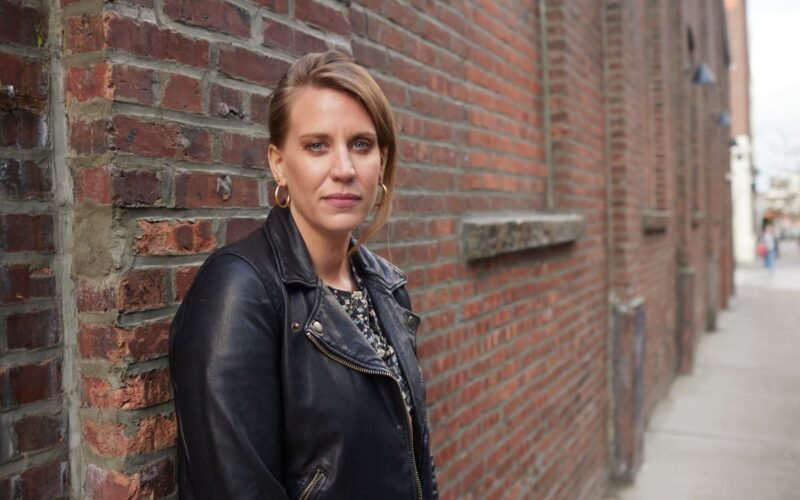
Following the film’s Best Producer nomination at the 2026 HollyShorts Film Festival, Schwan speaks with IndieWrap about reimagining the Western through an older female protagonist, directing Kerry O’Malley and Jamie Lynn Richards, and expanding Charlotte’s story into a feature.
Last Stand at Butte City uses the language of the Western to tell a story in which the decisive confrontation is psychological rather than physical. How did you balance the expectations of the genre with the film’s quieter exploration of grief, memory, and healing?
I love the language of the Western: the scale, the isolation, the sense of danger and survival are typical for this kind of film. But I was interested in turning some of those expectations inward. Charlotte prepares for the kind of confrontation we expect from the genre: she digs in, arms herself, and is ready to make a literal last stand. But ultimately, the battle she has to win isn’t against the railroad, it’s against thirty years of grief and trauma that have kept her in a self- imposed prison. I never wanted to abandon what makes a Western feel like a Western; I wanted to use those elements to add visceral layers to a more intimate story. The landscape is epic, the stakes feel enormous, but the real climax is an emotional one.
The railroad represents both historical progress and the destruction of Charlotte’s private world. Were you interested in preserving that moral ambiguity, rather than portraying it simply as a faceless antagonist?
Absolutely – I never really thought of the railroad as the villain of the story. Historically, it represented enormous change, connection, opportunity, expansion and progress, but that progress inevitably disrupted individual lives. I was much more interested in that tension than in creating a faceless evil for Charlotte to defeat, I wanted to use it more as a catalyst that forces her to confront everything she’s buried so deep. This isn’t simply acreage she’s being asked to leave, it’s the last physical connection she has to her husband, her daughter, and the person she was before so much loss. That’s ultimately what interests me: not whether the railroad is good or bad, but what happens when an external force makes it impossible for Charlotte to continue avoiding the internal change she’s resisted for decades.
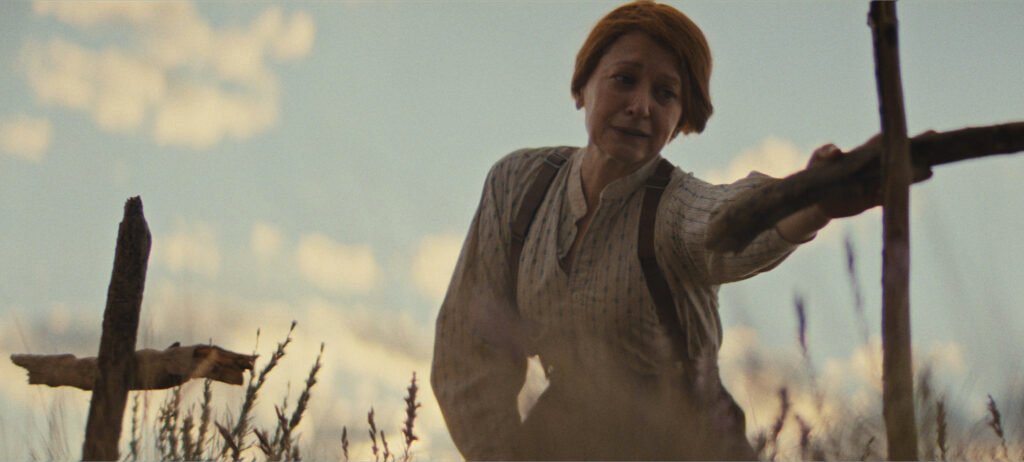
Charlotte’s homestead gradually comes to feel like both a sanctuary and a prison. How did you work with production designer Julia Sparr to ensure the location reflected the life Charlotte built there—and the trauma that has kept her from leaving it?
The homestead had to feel genuinely lived in, because Charlotte hasn’t simply occupied this place for thirty years, she has built an entire identity around it. This is the safe haven she’s built for herself: but it’s also a mausoleum of all she’s lost. Julia and I wanted every detail to suggest a life that had accumulated there over decades, rather than a beautiful period set that had been dressed for the camera. We talked about pieces she might have brought from her life before Montana – finer, softer feminine pieces from a home city on the east coast: hand mirrors, china plates, colorful dresses (both as props and as part of the costume design with Sarah Cogan).
Items that don’t necessarily fit on the frontier, but represent a much younger, hopeful, more delicate version of Charlotte before life hardens her. There needed to be something almost frozen about it: Charlotte has preserved this home because it’s her last tangible connection to the people she’s lost, but that preservation has also prevented her from moving forward. I loved that contradiction: everything around her contains evidence of a life, yet she’s living almost like a ghost inside it.
The film moves between Charlotte’s present and her younger years without heavily announcing those transitions. What visual language did you develop with cinematographer Kyle Deitz to distinguish memory from reality while keeping the two emotionally connected?
Kyle and I never wanted the memories to feel like traditional flashbacks that stopped the film and announced, “Now we’re going into the past.” I wanted that transition to feel more like how memory and trauma actually present: tiny snippets of interruption than a full disconnect from the narrative. A sound, an object, or a seemingly insignificant moment can suddenly bring you somewhere else. We created a warmer, softer, almost nostalgic quality for Charlotte’s happiest memories, particularly her early life with Jesse and Hazel. As those memories become more painful, that visual warmth begins to fracture as well. The present-day world is cooler and grittier, reflecting the guarded person Charlotte has become. So many of the same spaces hold both her happiest and harrowing memories, so what mattered most was keeping those worlds emotionally connected. We’re not visiting the past for exposition: we’re experiencing fragments of it as Charlotte does, understanding little by little why leaving this land feels impossible to her.
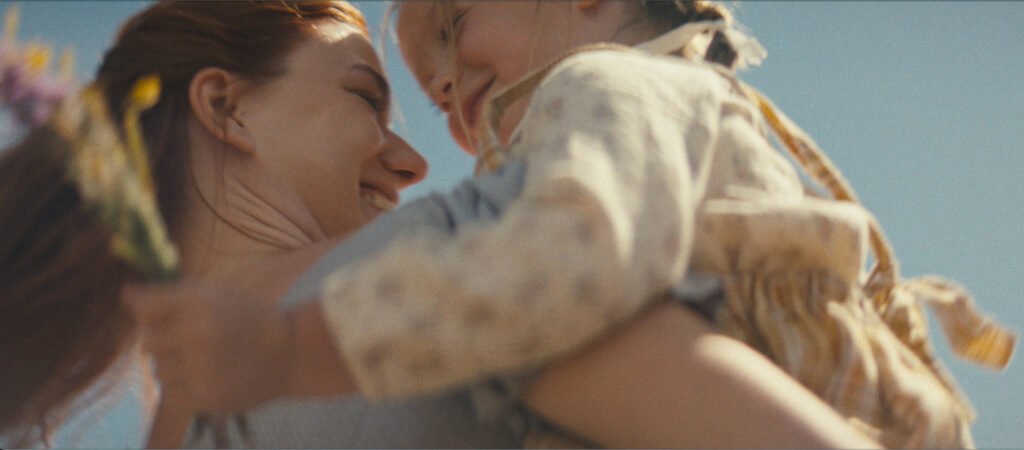
The unusually wide 2.39:1 aspect ratio gives the Montana landscape an epic scale while often emphasizing Charlotte’s isolation within it. What led you to that format, and how did it shape your approach to composition and blocking?
From pretty early on, Kyle and I discussed using anamorphic lenses. The extreme width of the framing also allowed us to hold two ideas in the same frame: the extraordinary scale of Montana and how incredibly small and alone Charlotte can feel within it. I wanted the landscape to be breathtaking, but I also wanted it to carry emotional weight. This is the place Charlotte loves more than anything, and simultaneously the place where she has isolated herself for decades.
The format gave Kyle and me the ability to use negative space and a sense of scale very deliberately, allowing Charlotte’s relationship to the environment to become part of the composition rather than simply a backdrop. So much of the landscape is a complex character in Charlotte’s world and it was an interesting exercise to capture that changing relationship visually. What once represented freedom and opportunity quickly turned into a brutal reminder of what living on the frontier would ultimately cost her. Westworld, Godless and the more recent 3:10 to Yuma were consistent comps we referenced for feeling and tone.
Kerry O’Malley communicates much of Charlotte’s history through silence, physicality, and restrained emotion. What conversations or rehearsals helped the two of you build a character carrying more than three decades of unresolved loss?
I think restraint was really important with Kerry and she really understood the character from our first Zoom meeting. We didn’t have a lot of luxury with time for in person prep and rehearsal, so we had a lot more conversation about who Charlotte was than me giving specific directions on how to play her. Kerry is one of the most gifted actors I’ve had the pleasure to work with, and I really could rely on simply giving her emotive notes versus specific action or tone direction. She truly embodied Charlotte from day one, which helped me trust her to carry the story. Charlotte could very easily have become a character who wears her trauma on the surface, but Kerry gave us a more compelling, and I think honest portrayal of how deep trauma and grief actually wraps itself up in our psyche. We talked a lot about the person underneath the armor. Charlotte is tough, stubborn and incredibly self-sufficient, but none of those things are the entirety of who she is. They’re qualities she developed because she had to survive. So much of her performance lives in what Charlotte doesn’t say: the way she moves through the house, reacts to another person getting too close, or allows a memory to register for just a moment before shutting it back down. I never wanted us to play “grief.” I wanted the audience to gradually discover how much effort it takes Charlotte not to feel it.
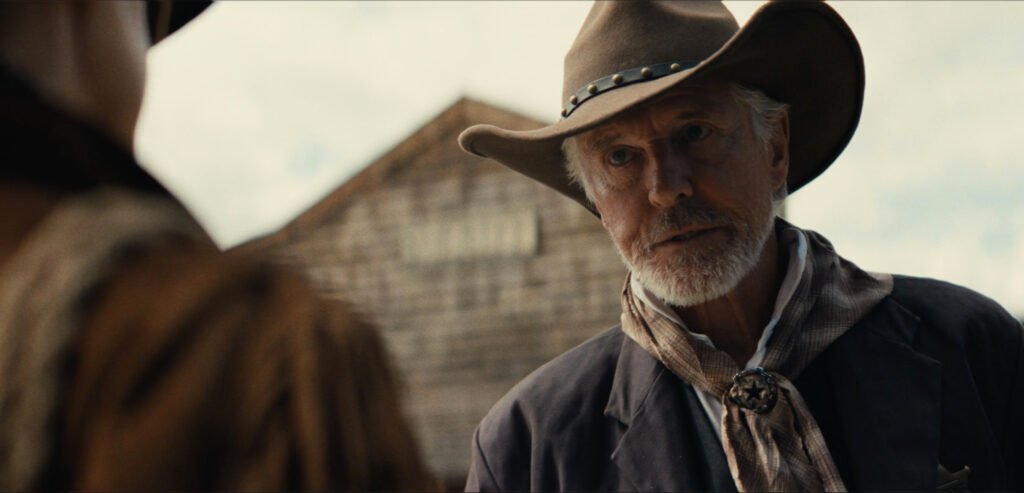
Jamie Lynn Richards had to establish the person Charlotte once was while making her feel continuous with Kerry’s older portrayal. How did you guide both performances so that the two versions felt like the same woman rather than separate characters?
I actually didn’t want Jamie to imitate Kerry, and they didn’t have rehearsals together since they never share a scene. I wanted them to feel like the same woman in two completely different states, shaped by everything that’s happened in between. Jamie understood the character so well from day one and is, truly, one of the most talented actresses I’ve ever been lucky enough to work with. She brought such honest, unfiltered love and joy to young Charlotte, while also giving us this incredibly visceral sense of loss when her world begins to fall apart. One of my favorite moments in the film is the heart-wrenching wail she gives when she buries her daughter. It still makes me cry every time I watch it, you feel it in your entire body. When we meet young Charlotte, we’re seeing the woman who existed before so much loss: she’s warm, bright-eyed, hopeful, and building the life she always imagined. Present-day Charlotte has spent decades burying that part of herself beneath all the armor she’s needed to survive. So the continuity had to come from somewhere deeper than matching mannerisms. We talked about the qualities at Charlotte’s core that never changed – her stubbornness, strength, independence, humor, and capacity for love – and how those same qualities would manifest very differently after thirty years of grief and trauma. Jamie gives us the emotional reference point for everything Kerry’s Charlotte has lost, which makes Kerry’s restraint that much more painful. To me, the tragedy isn’t that young Charlotte disappeared completely. She’s still there. Part of the film’s journey is watching that armor finally begin to crack enough for some of her to emerge again.
An unexpected act of compassion ultimately penetrates the isolation Charlotte has carefully maintained. Why was human connection—not victory over the railroad—the necessary turning point in her journey?
Because Charlotte doesn’t actually need to defeat the railroad, she needs to stop fighting her grief alone. After everything she’s experienced, isolation has become her form of protection, but that same armor that once protected her has also become her prison. What finally reaches Charlotte isn’t force or reason; it’s another person saying, “I also know what it is to lose something, you aren’t alone.” That moment of empathy gives her permission to finally stop surviving and actually grieve. I’ve always believed there’s tremendous healing in allowing ourselves to be known, particularly when vulnerability feels like the most dangerous thing we could possibly do. There’s a passage from C.S. Lewis’s The Four Loves that I included in the pitch deck from the very beginning, about what happens when we try to protect our hearts completely from being hurt. He describes locking the heart away where it’s “safe, dark, motionless, airless,” only to have it change in that isolation. That idea very much shaped the ethos of the film. Charlotte’s victory isn’t keeping her land, it’s realizing that leaving it doesn’t mean leaving her family behind, and that opening herself to another person doesn’t diminish what she’s lost. Once she realizes she doesn’t have to do it alone, the high price of loneliness for an illusion of protection no longer feels worth paying.
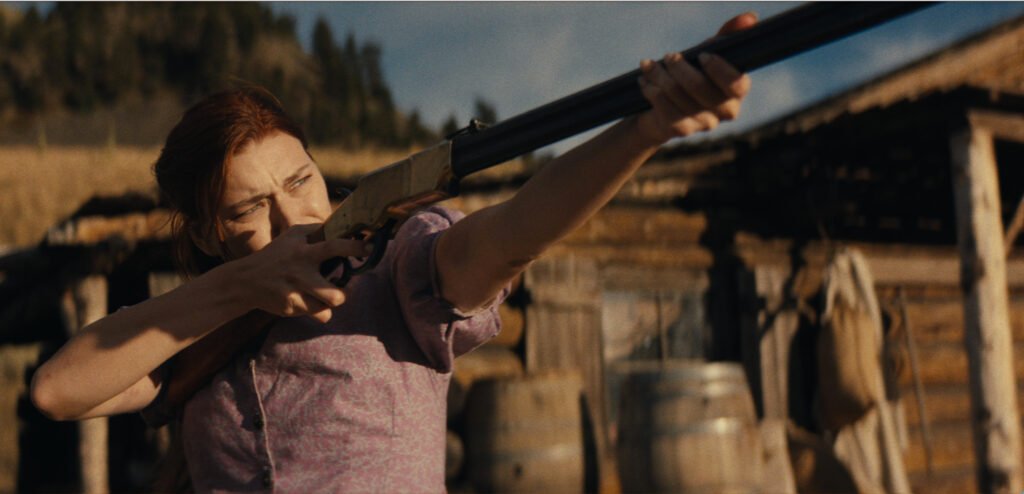
Oriana Soddu’s editing and Clark Rhee’s score help the film move between mounting urgency and moments of reflection. How did you determine when the film needed music or momentum, and when Charlotte’s experience was best served by stillness?
The biggest guiding principle was not to tell the audience what to feel before Charlotte was ready to feel it herself. Oriana and I were constantly looking at where we could pull back, where we could trust Kerry’s performance, and where the film needed to breathe rather than push forward. As a filmmaker, I rely so heavily not only on the incredibly nuanced skill set of editors, but on their fresh eyes. Oriana wasn’t afraid to tell me when moments I thought were working simply weren’t, or when something I loved would ultimately serve the film better on the cutting-room floor. I’m incredibly grateful for not just her eye, but her candor.
Clark’s score worked in a similar way. I love music, but I never wanted it to manufacture emotion that wasn’t already present in the performances and imagery. When the score enters, it should deepen something we’re already feeling rather than announce it. Clark is an incredibly gifted and collaborative composer, and I love that he also appreciates my background in music. He even arranged a song a wrote and sang that ultimately became our end-credit song, “Where I’m Bound to Go.” I really did put every fiber of my being into this film, so getting to put a little piece of myself and my actual singing voice into the music as well was incredibly special.
Because the film moves between urgency, memory, and stillness, rhythm became incredibly important. Sometimes the most powerful choice was momentum; other times it was simply staying with Charlotte for another beat and allowing silence, landscape, or sound design to carry the scene. I think a lot of what makes the film work comes from trusting patience: in the pacing of a shot, in moments of stillness, and in allowing the story to unfold quietly and deliberately rather than rushing the audience toward the next beat.
Following the film’s Best Producer nomination at the 2026 HollyShorts Film Festival, and with the short conceived as a proof of concept for a feature, what parts of Charlotte’s world or journey are you most eager to explore in a longer version?
My producer Susie Talbot and I were incredibly honored to receive a Best Producer nomination at HollyShorts for the short. We truly couldn’t have pulled this film off without her. Susie believed fiercely in the story from the very first draft of the script and carried that belief through every stage of the film, from pre-production through post. She’s an exceptional producer – not only incredibly tenacious when it comes to solving the countless logistical challenges of making an independent period Western, but also fiercely protective of the vision and heart of the film.
Having a producer who understands what you’re trying to make creatively and will fight just as hard to protect it is invaluable. We’re continuing that partnership as we develop the feature with Susie, Lila Claghorn, and their company, Puff Piece Productions.
The short gives us Charlotte at the culmination of more than thirty years of love, loss, and survival, but the feature gives us the space to really experience how she became the woman we meet at the beginning of the film. I’m particularly excited to spend more time with young Charlotte, watching her build this life with so much hope, and then seeing, piece by piece, how grief and trauma transform her. It also allows us to build out the community around her and make the arrival of the railroad much more complicated. I want to introduce characters Charlotte initially believes will stand beside her, only to watch that solidarity begin to crumble as circumstances change and individual interests take over. She gets this glimpse of community and the possibility that she doesn’t have to fight alone, and when that fails her, it only reinforces her belief that relying on anyone but herself is dangerous. So rather than extending the story far beyond the short’s ending, I’m interested in deepening everything that leads us there. By the time Charlotte finally makes that choice, I want us to fully understand what it costs her, and why choosing connection and allowing herself to move forward is such an enormous act of courage.
We can wonder hopefully about where she goes next, but for me, arriving at the point where she’s finally willing to go is the story.