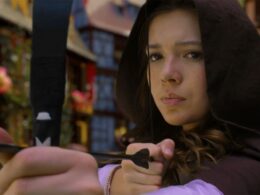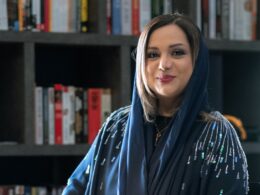




Blending absurdist humor with a genuine sense of threat, Jomehri uses one man’s determination to keep a few inches of hair to explore much bigger questions of identity, control, and the small freedoms we often take for granted. Following the film’s selection at the 2026 LA Shorts International Film Festival, IndieWrap spoke with Jomehri about finding comedy in oppression, recreating Iran in Los Angeles, directing Naderi’s wonderfully committed performance, and why sometimes resistance can begin with something as simple as refusing a haircut.
The Last Mullet begins with an almost unbelievable historical detail: Iran’s 2010 crackdown on so-called “Western hairstyles.” When you first encountered that story, what made you see it not simply as an absurd anecdote, but as the foundation for a film about identity and control?
The absurdity grabbed me first. People in charge looked at a mullet and decided it was a threat. They had a meeting about it. That’s funny until you think about what it means. Hair is a small personal thing that makes you feel like yourself, and controlling it is an old move. Women in Iran have borne the far worse end of that. The specificity of the mullet is what caught me. Partly because I have one. It’s nowhere near as glorious as Shervin’s. A mullet is sort of this ridiculous, playful thing. But in this context, there were real consequences attached. That tension felt cinematic.
The story probably also triggered some sort of childhood hair trauma. I have foggy memories from elementary school… leaving “Michael’s Barber Shop” super bummed with hair that was way too short. I’m sure Michael was just doing what he thought was best.
The film walks a very fine line between comedy and genuine menace. How did you determine how far you could push the absurdity of Shervin being hunted for his hairstyle without diminishing the reality of the oppression behind it?
The premise is absurd, but it’s also based in reality. Bobby Naderi brought a playfulness to Shervin. Not to mention the massive mullet he’s rocking. So the humor was going to be there. I didn’t want to push it so far that it undercut what was actually at stake. Played straight, the absurdity is just the world these people live in.

Shervin isn’t introduced as a political activist or someone deliberately trying to challenge the system—he simply wants to keep his hair. Why was it important that his act of resistance begin with something so ordinary and personal?
Shervin isn’t a fighter. He’s just a regular guy that likes his hair. A lot. It’s part of his identity, and he doesn’t want to cut it. He doesn’t set out to challenge anyone, but circumstance has made him a target overnight, and he has to deal with that. This kind of story feels very human to me. I’m more interested in the people than the politics.
Bobby Naderi brings a lot of warmth and mischievous energy to Shervin while still grounding him emotionally. What conversations did you have with Bobby about making the character funny without turning him—or his predicament—into a caricature?
He sure did. He gave such a wonderfully nuanced performance. The situation is absurd, but the themes are quite serious. Bobby and I talked a lot about the character and the world early on. We talked about playing it straight – a real person stuck in a ridiculous situation with very real consequences. We talked a lot about Shervin’s backstory as well. Who he is, who he wants to be, and what is holding him back. Even though it’s a short film that throws you into the middle of his current predicament, Shervin felt very real to us.

Siavash and the men enforcing the haircut ban could easily have been portrayed as conventional villains. How did you approach Ali Saam’s character and the idea of individuals becoming instruments of an oppressive system?
I approached Siavash the same way I approached Shervin. I wanted to know how he became an enforcer that chops mullets. I had this idea that Siavash used to be this legendary barber that was obsessed with his craft. An artist with shears instead of a brush. So the character had a history. Ali Saam took that and ran with it. He brought so much to the character. He gave Siavash power, but he also gave him a sense of artistry. A really warped one.
The chase through the streets gives the film an unexpectedly cinematic, almost adventure- film energy, while the situation itself remains ridiculous and frightening. What were some of your visual references for those sequences, and how did you and cinematographer Daniel Satinoff develop the film’s visual language?
For the chase sequence specifically, I rewatched some of the Bourne movies. I like how visceral they feel. There’s a rawness. I also re-watched Chungking Express and some of the original Indiana Jones films. Of course, we didn’t have that kind of budget. Not even close. So Daniel and I had to figure out how to achieve the energy without the scale. We shot handheld, using natural light. We kept the lenses tight. That was partly the budget and partly the point. It kept the chase feeling like something happening to a real person. The visual language had to hold both sides of the film… the absurdity and the threat.

You recreated 2010 Iran in Los Angeles, using everything from locations and wardrobe to objects borrowed from your parents’ home. Were there particular details that felt especially important to you in making that world recognizable and authentic?
A lot of it was about accumulation. No single detail was going to make Los Angeles feel like Iran. It was about layering in enough small, specific things that it started to feel lived in. Our production designer, Michelle Patterson, and her team scoured LA for authentic details and textures that carried the richness of Persian culture — textiles, samovars, books, artwork, instruments, food, and a lot more. Some of the objects in the film actually came from my parents’ home, which made it personal. Those were things I had grown up around, so they had a familiarity that’s hard to manufacture. The locations, wardrobe, props… all of it had to work together.
The relationship between Shervin and his mother ultimately brings a much more intimate emotional dimension to the story. Why was the family dynamic important to you, particularly as the consequences of Shervin’s seemingly small act of defiance become more serious?
The relationship with his mother made the story feel multigenerational. She’s a woman who has spent decades being told how to dress and present herself by many of the same forces now targeting her son. She understands that kind of control in a way Shervin doesn’t yet. And it doesn’t stay in the street. It follows you home.

As an Iranian-American filmmaker whose family fled Iran in the 1980s, you’ve spoken about wanting audiences to see ordinary Iranian people beyond governments, violence, and headlines. How did your own relationship with Iran—from both inside and outside the culture—shape the way you chose to tell this story?
Iran has always felt both very close and very far away. My family left in the 1980s, but the culture came with them — the food, the music, the rugs, the humor, the stories. All of it was present in our home.
The Iran that exists in my mind is made of fragments. Memory, family albums, stories passed down. I leaned into that rather than trying to present a definitive version of Iran. In a way, the film reflects my own relationship with it. Personal and familiar, but also imagined.
The film is specifically rooted in an event from 2010, but its questions about appearance, individuality, and authorities policing personal expression feel much broader. What do you hope stays with audiences after the comedy of The Last Mullet fades and they begin thinking about what Shervin is actually fighting to preserve?
I hope people remember Shervin. A guy who ran, hid, and finally stood his ground over a few inches of hair. Maybe they feel a bit of what he feels when this tiny, personal thing is suddenly taken from him. And maybe they leave wondering: what if the little things I take for granted were taken away?