




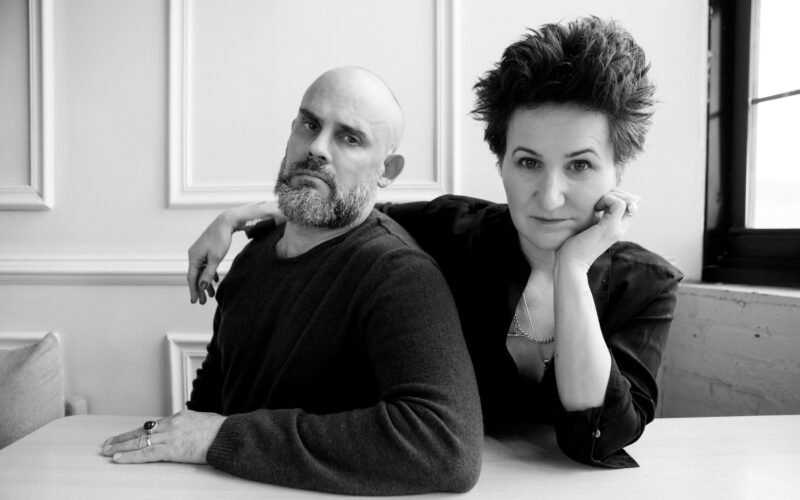
Using deliberately imperfect rotoscope animation, the Londons transform a real-life experience into something dreamlike and emotionally ambiguous, where nostalgia exists alongside unease and humor alongside vulnerability. For the filmmakers, that tension is precisely the point: they are less interested in recreating the past than in capturing the fragments and sensations that remain decades later.
In conversation with IndieWrap, Andy and Carolyn discuss memory, changing cultural norms, their decades-long creative partnership, and why they continue to find their artistic sweet spot somewhere between the cringeworthy and the beautiful.
1981 is built around a memory that is both deeply personal and strangely universal. Looking back now, do you think the film is more about what happened that night, or about how memory reshapes events over time?
Carolyn: I think it’s about the latter. The film is really about memory. How we remember, and how those memories become imprints for later things in our lives. It’s less about remembering every detail of what actually happened and more about the motifs and small details that stay with us.
Andy: We wanted to capture the feeling of a memory rather than simply reproduce the memory itself.
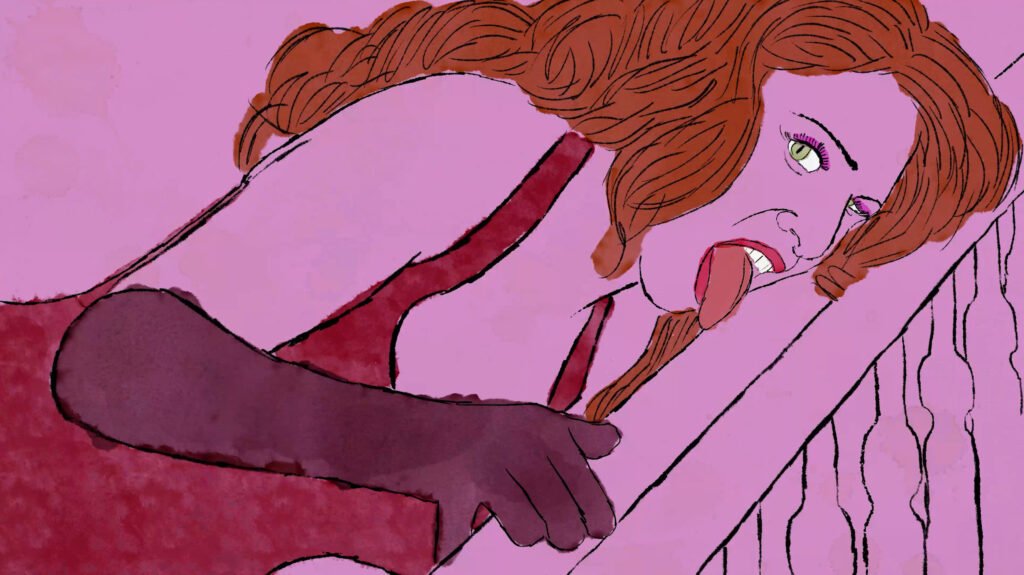
One of the film’s greatest achievements is that the burlesque sequence feels simultaneously beautiful, unsettling, and almost dreamlike. How did you choreograph that emotional contradiction without pushing the audience toward a single interpretation?
Carolyn: We thought about the burlesque dancer, Minnie Tonka (the actress and dancer) almost as a feminine divine, a goddess-like figure. We wanted her to be beautiful, alluring, sexy, and for the boys — confusing. There’s not a single interpretation on it, but more the idea that all those feelings and emotions can live alongside each other.
Andy: The actual experience was almost the opposite of beautiful. It was confusing, cramped, haphazard, and, in many ways, ugly. But that felt like a very limited place to start a film from…but also this is a narrative film, not a documentary. We’re interpreting and transforming an experience.
Carolyn: The dancer becomes almost larger than life in Douglas’s memory. In this room full of adults, she is somehow the only actual grown-up, and she sees Douglas for who he is
The parents in 1981 are never portrayed as villains, despite making a decision that feels shocking today. Why was it important for you to approach them with empathy rather than judgment? And what does that reveal about changing cultural norms?
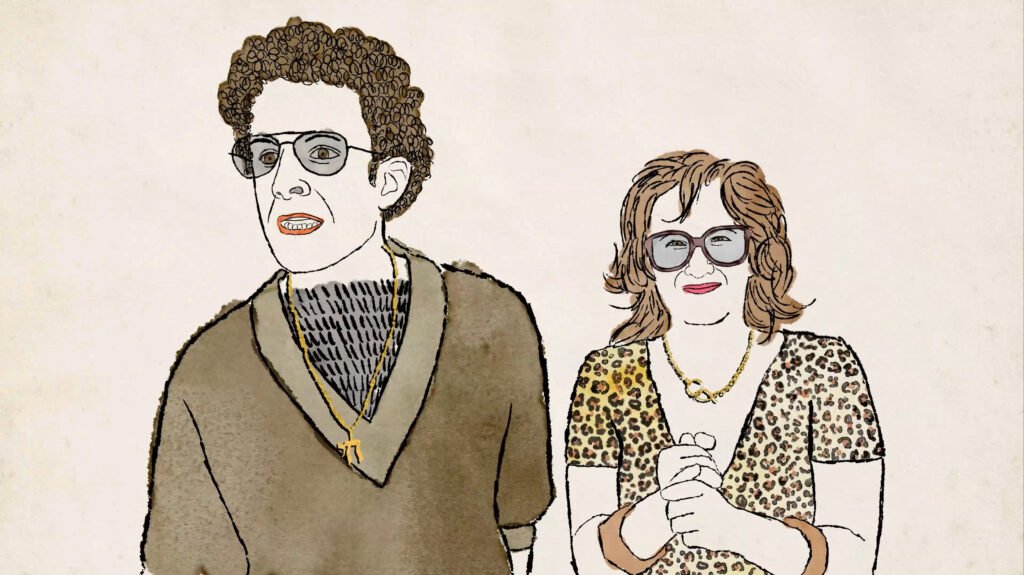
Andy: I didn’t want to judge the parents because I actually loved them. I understood that, in their own minds, what they were doing was something special.
Carolyn: The film is called 1981 for a reason. It’s timestamped. There was a different way of thinking about these norms at the time, particularly in this culture and this particular town. Bringing a stripper to the party was seen as a transition to manhood, a kind of transition into adulthood. The parents were proud of it. They genuinely believed this was what young men needed to become adult men.
Andy: Of course, by today’s standards, it’s shocking, and we recognize that those norms have changed. But there is also an innocence to the way these parents think about it.
Carolyn: There’s something almost weirdly wholesome about their attitude. They think it’s groovy. They’re sex-positive. They believe they’re doing something important. And in our world, the dancer herself is gracious and magnanimous. She sees Douglas for who he is.
Andy: At the same time, 1981 feels like a bookend to what’s happening now. There are interesting parallels around the patriarchy and the ways people justify cultural norms that may seem inexplicable from another historical moment.
The rotoscope animation creates the sensation of watching a memory that is slowly fading, but refuses to disappear. Were there moments where the imperfections of the medium actually communicated emotion better than traditional animation could have?
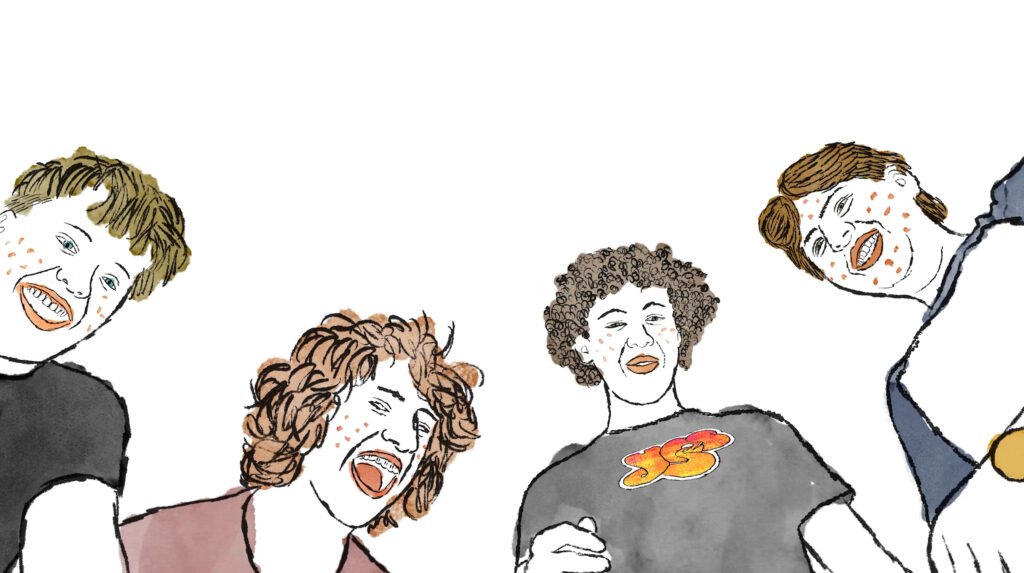
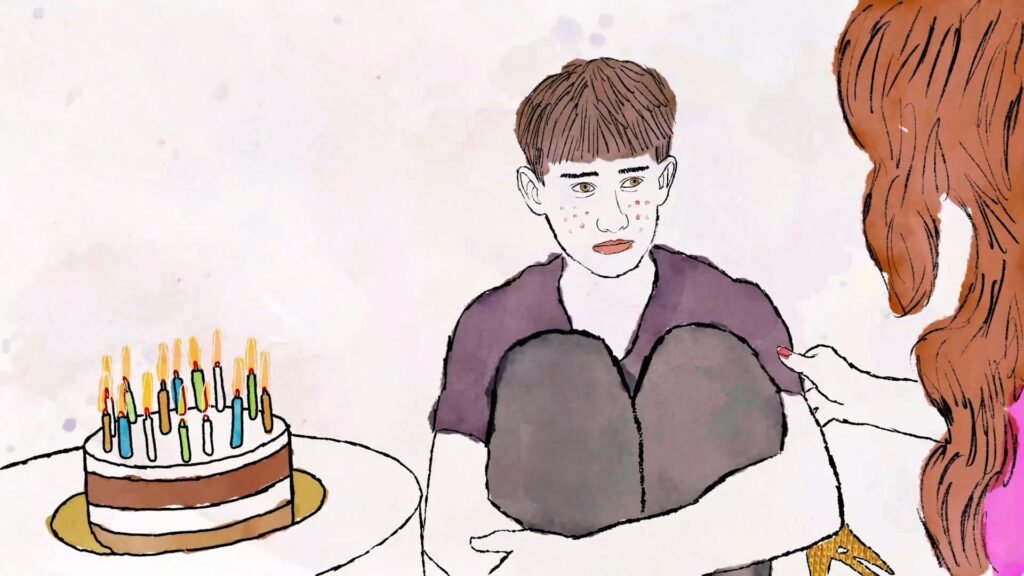
Andy: Absolutely. That was a design choice, and we chose rotoscoping for exactly that reason. A lot of the aesthetic is intentionally analog. We didn’t want to be able to simply “Command-Z” or “Control-Z” every incongruity or imperfection. We wanted the medium to speak for itself and capture the messy feeling of 1981.
Carolyn: It was an un-airbrushed time. People weren’t constantly correcting themselves or smoothing everything out. If you were fat, you were fat. If you had pimples, you had pimples. There was a physical imperfection to the world that we wanted to preserve. That’s the feeling we were trying to capture. The feeling of a time before everything was polished and airbrushed.
The film captures that confusing period where teenagers perform confidence while privately feeling completely lost. How much of Douglas’s emotional journey comes directly from lived experience, and how much emerged during the writing process as you revisited those memories together?
Carolyn: A lot of it emerged through the writing process.
Andy: The truth is, the real Douglas I knew was actually quite happy about having the stripper in the house. But that would have led to a much more superficial story.
Carolyn: Douglas is a creation. He’s a narrative composite of people we’ve known, lived experiences, other people’s experiences, and things we’ve observed. What we can connect to very clearly is the feeling of performing for your friends while feeling something completely different inside. That feels very true to adolescence.
Andy: But Douglas himself is a fictional character. He’s a composite rather than a direct portrait of one person.
Your films often explore uncomfortable subjects without feeling cynical or exploitative. Do you think audiences today are becoming more open to stories that embrace ambiguity, or has it become harder to create work that deliberately resists easy moral conclusions?
Carolyn: I don’t really know. We just make the films we make. We’re not very black- and-white people. We live very much in the gray area of life, and I think our films reflect that. Neither of us has fixed ideas about the way things should be.
Andy: We definitely want to entertain an audience. We think that’s an essential part of filmmaking. But we also have faith in our audience. We don’t want to spoon-feed them or make something neatly packaged. We want the audience to work a little bit, to connect the dots. I think it’s more satisfying that way, and it’s less didactic. It’s simply a better way of making films. We show them don’t tell them.
Music, fashion, hairstyles, and even the cluttered suburban basement became emotional storytelling tools rather than simple nostalgia. How did you decide which details would authentically evoke 1981, and which risked becoming nostalgic clichés?
Carolyn: We went through an editing process even with the symbols and ideas. There’s a first level of imagery that comes to mind because everybody has access to it. Then we try to reject some of that and become more anthropological. We ask: What was really happening in that suburb? What was really happening in that basement?
Andy: The process of developing the props and costumes was multilayered. It started with mood boards and Pinterest boards, then moved into trips to flea markets and vintage stores, and eventually to things we found on eBay.
Carolyn: We treat these films as though we’re costume designers and production designers. We research the period and work through different iterations. A lot of things get left by the wayside because they simply feel too obvious or too clichéd. The goal isn’t nostalgia. It’s authenticity.
As creative partners for more than two decades, you’ve spoken about trust being essential to your collaboration. When working on such autobiographical material, how do you challenge one another without losing the emotional truth at the heart of the story?
Andy: There’s definitely some fighting. But there’s also an implicit trust in each other that comes from all the years we’ve spent making things together. For us, the film exists outside of each of us. It’s almost like a third person in the room. There’s me, there’s Carolyn, and then there’s the film.
Carolyn: We’re able to put our differences and our egos aside and ask, is this serving the film? We can put everything in service of the story. That does lead to fighting and skirmishing, but it’s all done in good faith. We both want to make the best possible film. And as far as the autobiographical material goes, autobiography is really a launching point for us. We’re not making documentaries; we’re making narrative films. We care more about getting something emotionally correct than factually correct.
Andy: It’s also more interesting for us when we can add fiction and heighten things. That’s something that has evolved throughout our film work. Some of our earlier films were more documentary-like, whereas now we’re much more interested in the possibilities of fiction.
Premiering at Sundance introduced 1981 to audiences who may have grown up in completely different countries and cultures. Have you been surprised by the aspects of Douglas’s experience that viewers seem to connect with most strongly, regardless of where they come from?
Carolyn: Not really. We think there’s something very universal about Douglas and his story. There are people all over the world who are Douglases—or who know Douglas-type people.
Andy: That said, the film is somewhat polarizing. Some people really love it, while other people are genuinely perturbed by it, which we didn’t necessarily expect. It seems to unhinge something in some viewers. We’ve even had people who were offended by its portrayal of Judaism.
Carolyn: But generally, we don’t think the film is tied to one particular culture. In fact, it’s the specificity of the culture that makes it feel universal. The same is true of the time period. The specificity of 1981 is what allows people from very different backgrounds to connect with it.
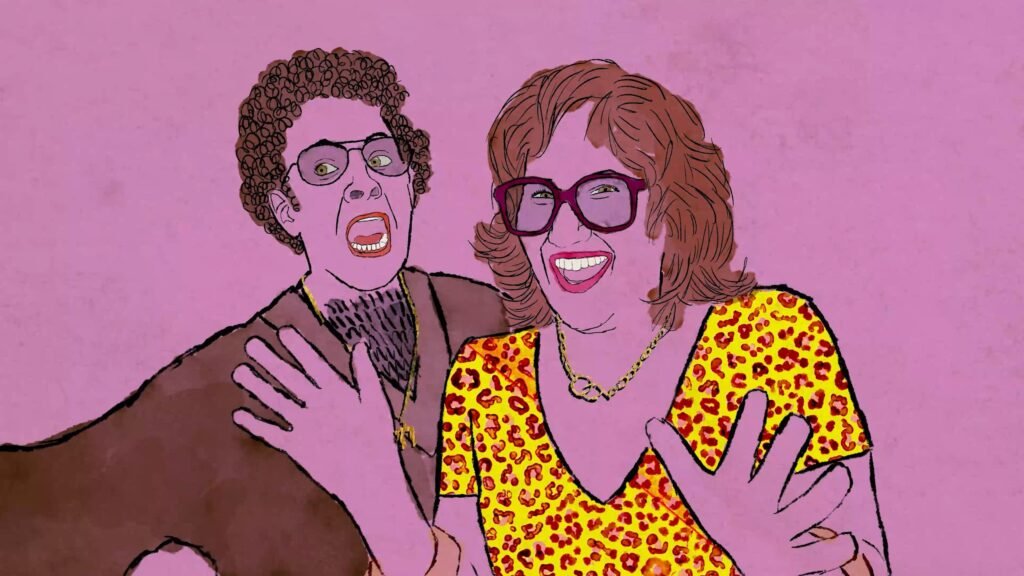
Your director’s statement says you strive for “the space where cringeworthy awkwardness meets heartbreaking beauty.” After 1981, what kinds of uncomfortable truths or forgotten memories are still calling to you creatively? And do you feel this film opens the door to exploring them on a larger scale?
Carolyn: Absolutely. 1981 is the proof of concept for a TV series we’re developing in the same style called “Clam Cove”.
Andy: Clam Cove is the world of 1981 but expanded to an entire town. We’re pitching it as a strip-mall Little House on the Prairie. It’s about the decade of the 1980s in this small town and how that decade affects a town and is seen through the lens of our main characters, the Dresden family.
Carolyn: This particular film and this era open up a lot of questions for us. We’re actively grappling with where we come from, our parents, being parents ourselves, being kids, and raising kids. We’re interested in what you inherit as a parent and what you pass on, as well as the effect of the culture and politics around you. The TV series gives us a much bigger framework in which to explore all of those things.
Andy: And beyond that, we’ll definitely keep making projects that live somewhere between the cringeworthy and the beautiful. It’s become something of a hallmark for us. We like cringeworthy and beautiful. We think that’s where the sweet spot of life lives.