

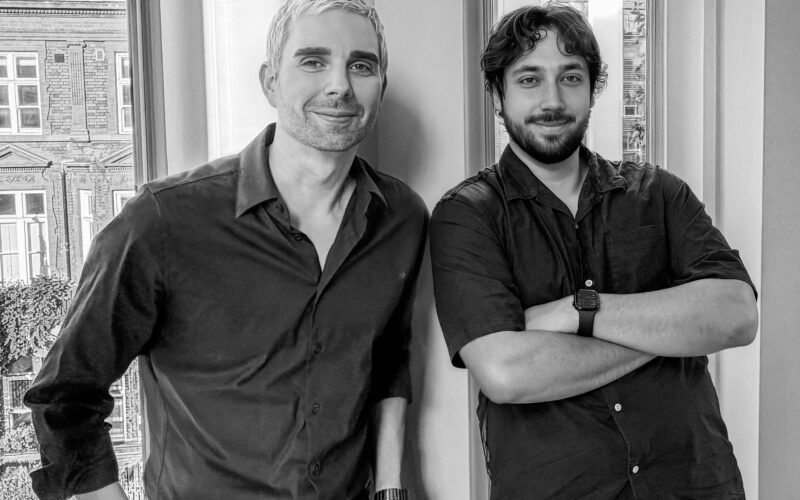
Following the film’s world premiere at the 2026 Annecy International Animation Film Festival, Meade and Rockefeller spoke with IndieWrap about translating silence to the screen, discovering the emotional possibilities of Death and his apprentice, and why kindness might sometimes be the most effective way to get the job done.
Nicholas Gurewitch’s original book is wordless and only twenty pages long. Jonathan, when writing the screenplay, how did you decide what could be expressed through dialogue without diminishing the ambiguity and visual storytelling that made the book so compelling?
JR: Nicholas’s illustrations are so detailed and seductive that you can spend an extraordinary amount of time with it. I was captivated the moment I first read it, and thought immediately that it would make a magnificent film. When you read a book, though, you look at a panel and your mind fills in the edges. Film keeps the story and pace moving whether you’re ready or not. So the first thing we had to accept was that we couldn’t simply transcribe the silence. We had to find its equivalent.
I became quite strict about dialogue not telling you what you could already see. If an image is doing the work and then somebody explains it, you’ve rather killed the image. So dialogue
became more about character. Death grunts and groans; he never emotes words as such. That is mirrored in his apprentice Little Death, in a much sweeter register.
The film brings the relationship between Death and Little Death to the foreground much earlier than the source material does. What did that structural change allow you to explore about mentorship, parenthood, and the expectations one generation places on the next?
JR: In the book, Little Death doesn’t arrive until roughly halfway through, and on the page that is a beautiful reveal. But spending half the film with one character before meeting the person the story is actually about would be a frustration on screen.
More importantly, it changed whose story we were telling. In the book we’re looking at Death, to a large extent through his therapist. Little Death is part of the explanation for what’s gone wrong with him, and why he’s no longer good at his job. It’s much more interesting to see those events actually go wrong.
And that became much more interesting to me because Death thinks he’s being a very good mentor. He’s desperately trying to teach his apprentice how to do things properly, and she desperately wants him to be proud of her. He thinks he’s failing, she’s trying her hardest – and the best drama occurs when everyone is “right”. It’s all a matter of perspective.
LM: Well said, when we were storyboarding the film, and god did we storyboard the crap out of the beginning, I think in total we had around 50 versions. We toyed with the idea of where and when to introduce little death. And actually who do we start with, whose story is this about? I love the way we start the film now, Death in his element, everything shivering before him as he makes his slow walk up towards the kill, only to be interrupted by the little ball of cuteness trailing before him, levelling him down into what he really is: A father. We wanted to establish this dynamic as soon as possible to be able to delve deeper into it throughout the film.
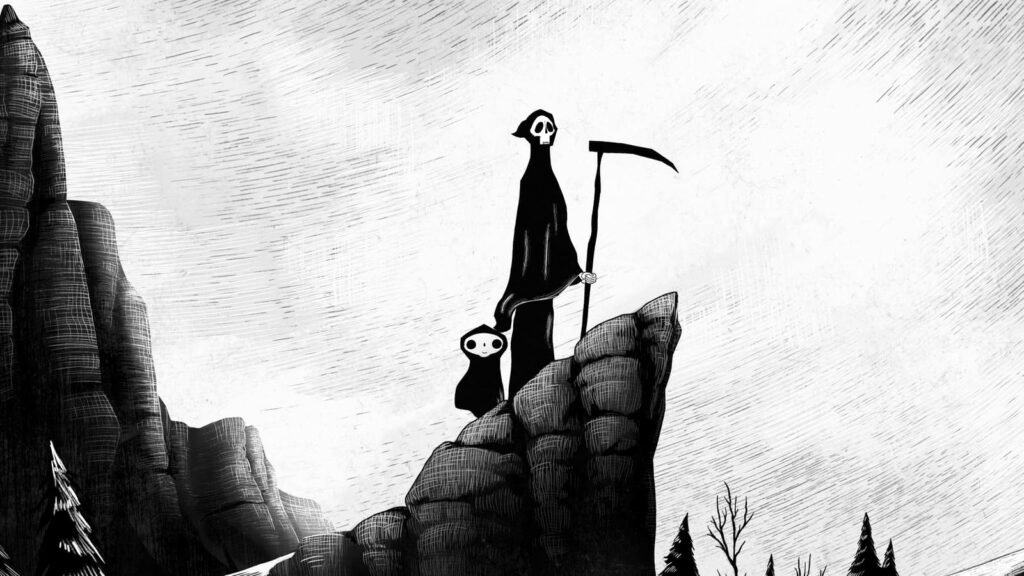
Little Death’s compassion initially appears incompatible with the role she is expected to inherit. Were you interested in challenging the idea that kindness and professional competence are somehow opposing qualities?
JR: Very much, and I would put it more strongly: I don’t think the film ultimately regards them as incompatible at all. Not to spoil the ending, but Little Death is more successful than her mentor – through very unconventional means.
But let’s not cut Death too much slack either. He has mistaken hardness for rigour, which is an easy mistake to make when you have done something for a very long time. And the way Little Death finally carries the mantle of the grim family business – entirely on her own terms – wins her not only acknowledgement and love, but kudos and respect.
The idea we kept returning to is that the problem was never failure. It was method. And the joke, which we hope lands as rather more than a joke, is that the gentler way turns out to be the better way of doing the job. She’s a little killing machine, in the nicest possible way.
LM: That’s a really interesting question, I guess I never saw it like that but now that you mention it I guess directing can fall into this role sometimes. We are told stories about great directors and how horrible they are and I can’t help but sometimes be jealous of their passion and insanity. That being said like little death teaches us, I think there are other ways to do things, maybe sometimes even more effectively.
The man Death has come to collect ultimately becomes his unlikely adviser. What interested you in reversing their expected roles, and how did you find the right balance between the scene’s absurdity and the emotional truth beneath it?
JR: There’s a lot of role reversal going on in this film, and a lot of absurdity; but life is absurd, isn’t it? Death as a personification is absurd to begin with, and giving him a little girl as an apprentice – one who loves flowers and animals – is more absurd still. The best way to deal with absurdity is like in Monty Python – don’t acknowledge it. The characters play everything
absolutely straight and carry on with sincerity, and we the audience can recognise and find humour in how absurd the situations are.
Death failing at his job a reversal of fortune, but honestly his schemes to cut a life short are
extraordinarily convoluted in the first instance – whether it’s pushing a boulder off a cliff, or sending a moth to distract a cat and setting off a chain of events. There’s a bit of Wiley Cayote about him – he could simply swing his scythe and be done with it, but I think Death believes there is an artistry to his job.
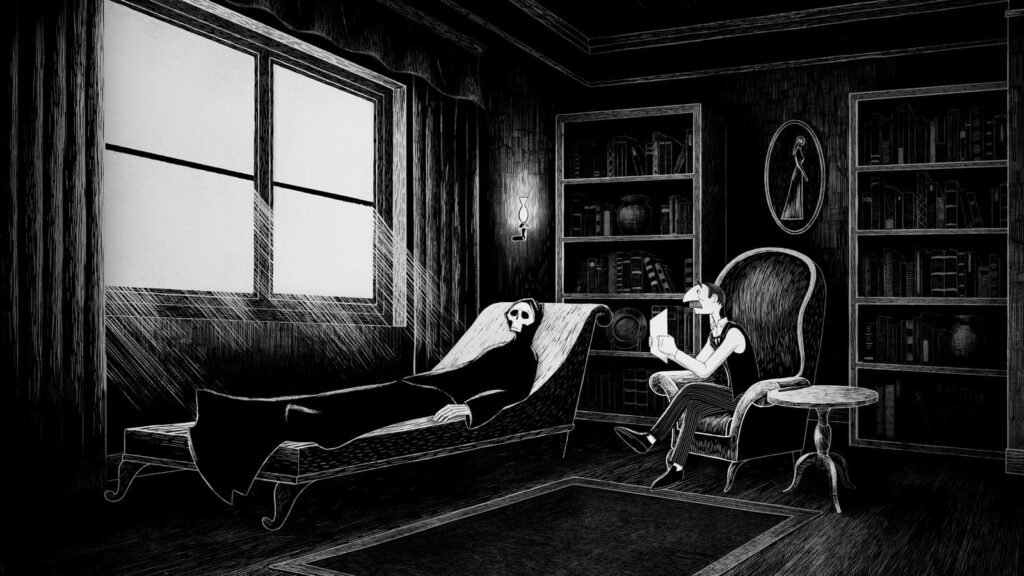
The fact that his therapist, who was his intended victim, helps him arrive at his breakthrough is darkly funny, but also fitting. Emotionally, the man he has come to collect has no stake in
Death’s dignity, no career to protect and, in the most literal sense, nothing to lose. That makes him the one person in the world Death might actually listen to; but I think there’s something wonderfully hubris about him being much more concerned about his doctorate than his own safety, and being more concerned with his patient having a good professional session than his own mortality.
LM: I love psychologists, they are such bizarre characters to me. They hold such an important duty within our world, by sort of sitting on the fence outside of it. Death has a lot of similarities to this. They feel like two sides of the same coin in a sense that they have a duty to fulfil regardless of who their client is. At the end of the day they both go to extreme lengths to get the job done.
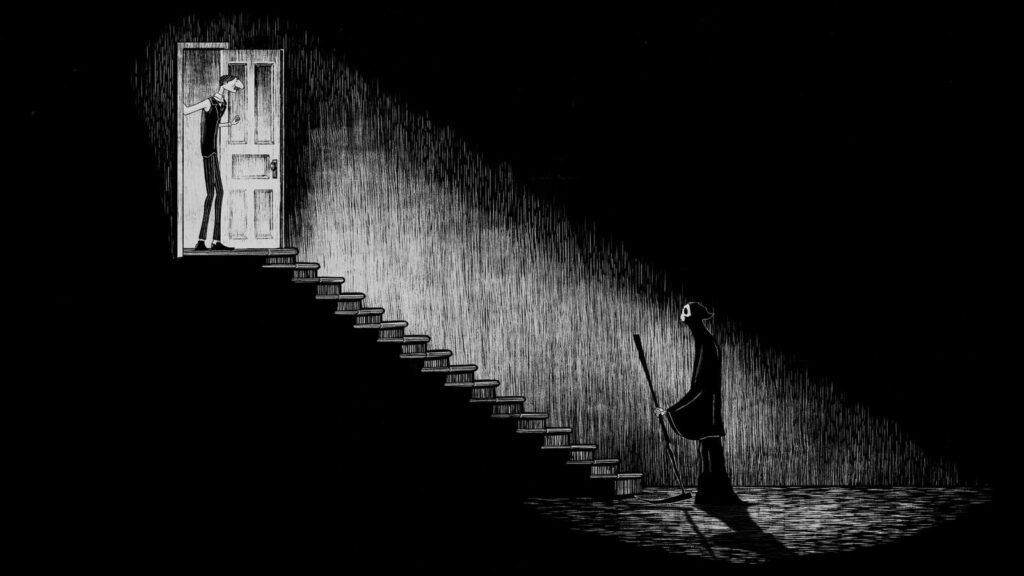
The film’s predominantly monochrome world makes its rare bursts of colour especially striking — from the flower that captures Little Death’s attention to the chaotic imagery accompanying Death’s frustration. How did you develop colour as an expression of their contrasting inner lives?
JR: The discipline of the black and white came first. We approached it rather as you would approach black-and-white photography — where is the black point, is there enough gradation in the whites, how many greys are genuinely in play. It reads as black and white, but there is a great deal of tonal information in there, which is what gives it the depth of something coming off a printing press.
The unexpected pop of colour carries everything symbolic about Little Death — her curiosity, her sweetness. Later, in Death’s therapy section, that same burst of pink returns in a flower and expands into what we came to call “murderous pink”: the identical agitation, seen through Death’s eyes rather than hers. So in a black-and-white film, colour plays an entirely emotional role.
LM: Pink has a power to it, it holds a lot of cutesy archetypes which were fun to lean into and push away from. Death as this primordial god of destruction, felt to us that he could only truly be afraid of the overly, disgustingly cute.
Your visual language depends on dense cross-hatching, physical printmaking textures, and deliberately imperfect handmade marks. Leto, how did you determine which elements needed to be created physically and which could be completed digitally without losing that tactile quality?
LM: My one hill that i was ready to die on was texture. Thankfully everyone was super down with the idea and hence I am alive and kicking. So much can be done well digitally these days, especially in the hands of talented artists. But real texture is effortless in the real world. Ross Hogg is an amazing Scottish animator and filmmaker – I had seen his film ‘4:3’ in Vienna years ago and it stayed with me: a beautiful, tactile, scratched on 35mm film that just filled my eyelids with lovely texture. We spoke a while back and I heard he had moved into Linocuts and traditional etching prints in Edinburgh and so I asked him if he could help us out. He created some gorgeous, huge scans of etched textures which we incorporated into many aspects of the film.
When we had to go digital – for the texture on the characters for example, we made sure to carefully develop techniques that would emulate the hand-etched nature of the source material, so we had special brushes developed for the animation software to achieve this.
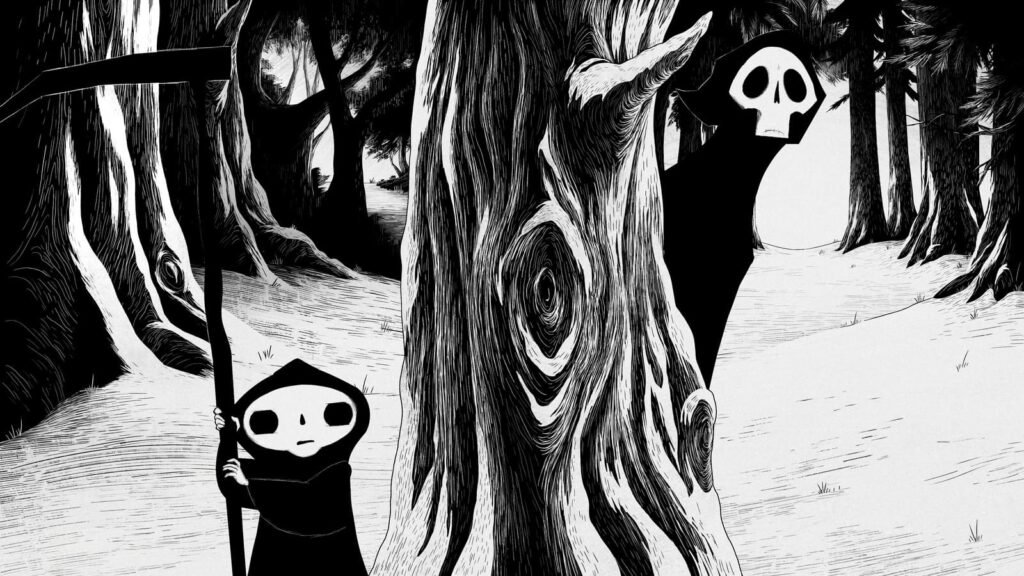
Death and Little Death have minimal facial features, yet their personalities and changing relationship remain remarkably legible. How did you work with the animators and voice performers Nami Annette Gillet and John Sparkes to build such expressive characters through movement, timing, and vocal performance?
JR: One of the techniques in voiceover work is sometimes getting the performers to act out
what they’re doing, so they can really feel the breath and expressions in their body. So nothing is forced; it feels very real and very genuine. Of course, working with great talent helps a lot! Some people might recognise John Sparkes as the farmer in “Shaun the Sheep”. He’s brilliant at incoherent mutterings and emoting with very few words. Nami is a natural. I don’t want to say that she’s very much the character of Little Death (but she is). She’s playful and sweet, with a wickedly dark sense of humour for her age, and she nailed everything in very few takes.
LM: It’s funny, so much of the acting is done through the body that the faces were secondary. We spent a long time in development with Sophie Bird (our story artist) figuring out how to capture the personalities in the design and movement of the characters. When the feeling is expressed through the body, the face doesn’t need to do so much heavy lifting. We didn’t want over-exaggerated facial features and wanted to keep the features simple – so it was just a process of trial and error to get to a design that worked. After that a lot of work went into the storyboarding process, posing and acting with our animators. Once we had a strong baseline we recorded our lovely voices. John and Nami brought so much life into the characters and really made them their own. They both had such an innate sense for the timing and nuance of the scenes that we really didn’t have to intervene that much.
The film moves between gothic fable, workplace comedy, family story, and moments of genuine melancholy within only twelve minutes. How did editing, music, and sound design help you manage those tonal transitions without making the film feel fragmented?
JR: Our editor Georgia Zarantonello and our story artist Sophie Bird were two of the core sounding boards as we pieced together the animatic, or the many animatics, I should say. This enabled us to have a crystal clear sense of where every story beat was as we headed into production; and we even started on the score very early on in the piece, as it plays such a pivotal role in letting us switch through so many gears so seamlessly.
What we also had to find is a beautiful cinematic equivalent for what the silence could do – and take advantage of all the other fantastic tools in our kit – especially the soundscape. We knew from the start we wanted genuine authentic sounds (not cartoon Looney Tunes sounds!) and our sound designer Miles Sullivan was equally passionate about that. I love the fact that the scythe is a genuine scythe that was recorded just for the film.
Equally, what the film needed was really emotive music that could help carry the emotional weight of the whole thing. Even before we completed the final draft of the animatic we
challenged our composer Alastair McNamara to write a theme around each character that could be woven into the grand narrative; and because of that we can dip in and out of characters and emotional beats like gears in a car.
LM: Editing in animation is a very different beast to live action as Giorgia Zarantonello (the film’s editor) can attest. It’s a slow yet constant discussion between the departments. We had weekly edit sessions where we built the film out of scrappy little drawings, temp sound effects and simple melodies.
I love the process and it truly feels collaborative, you get to debate and discuss all about movement, rhythm and character performance. Having an editor you trust is vital.
You come from different creative backgrounds — Jonathan from writing, theatre, and live-action filmmaking, and Leto from animation and experimentation with the medium. How were those perspectives divided or combined during the co-directing process, and where did each of you most challenge the other?
JR: On paper the division is somewhat clean: Leto leading the image and the craft, me leading the story and the emotional architecture. In practice it was far more porous than that in both directions, and much better for it. I mean that’s the ethos of the film, isn’t it? Approach everything from different perspectives to get the best result?
We challenged each other equally, and what made it work was that we wanted the same film and had no ego about who reached it first. The rule was simply: may the best idea win. Animation makes that relatively easy, because you are surrounded by extraordinary artisans and the good ideas genuinely come from everywhere. Your job becomes curation, rather than authorship. We are sieves.
LM: It worked well as it gave us both space to excel in our respective strengths. During pre-production I could be playful and deep in the animation process, I really had fun experimenting with the technique using sand animation and etching among other things to see how we could capture the effect we were going for.
A Little Death had its world premiere at the 2026 Annecy International Animation Film Festival. What did you learn from seeing the film with an audience for the first time, and were there any reactions that surprised or particularly moved you?
JR: Annecy is so wild! I love how everyone is so enthusiastic about the craft of animation.
Personally, I love the fact we have a relatively silent film that can make an audience laugh out loud and leaves people with a small tear in their eye at the end. It’s a pretty incredible feeling to have a cinema full of people all pretending not to wipe away a tear as the end credits roll.
Seeing them embrace these characters and walk out saying “this should be a feature film” (I’m only slightly paraphrasing) is the best reaction we could have hoped for.
LM: The feeling of the animation community coming together at Annecy is quite special – so it was a real treat to be there with the film for it’s premiere. Being able to share the film with an audience that all deeply care about animation is the best we could have hoped for. We had some lovely reactions and discussions after the screening. It was interesting observing the points where people laughed – we found the subtle very dialed back ‘gags’ actually got the biggest reaction which was unexpected.