




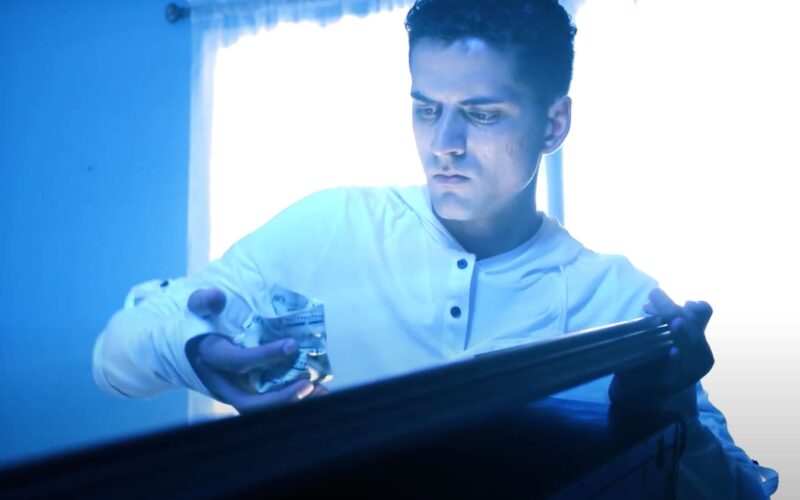
Produced in collaboration with the Los Angeles Film School and Untold Storytelling, the film follows a composer struggling with creative block who encounters a mysterious version of himself in an alternate, empty reality. When discarded sheet music mysteriously reappears, it sparks a journey of self-discovery, exploring inspiration, creativity, and unexpected moments of artistic insight all told without spoken words.
Working closely with award-winning writer, director, and sound designer Ethan Grover, the film’s creative team crafted a visually and aurally rich narrative that merges conceptual sophistication with emotional resonance. Grover’s sound design drives the storytelling, using ambient sounds, subtle effects, and carefully timed auditory cues to convey mood, tension, and the composer’s internal states.

Cinematographer James Nield played a pivotal role in translating the story into compelling imagery. His lighting, framing, and camera movement bring Grover’s vision to life while adding a distinctive cinematic style that enhances the psychological and emotional layers of the story.
Nield’s cinematography is central to the film’s storytelling. He created deliberate visual contrasts: cold, desaturated tones mark the alternate reality, evoking emptiness and isolation, while warmer palettes in the composer’s real world convey intimacy and familiarity. Subtle camera movements, carefully planned framing, and layered lighting techniques ensure each shot supports the narrative’s emotional arc. In one sequence, Nield used a single diffused light through a sheer curtain to mimic soft, natural sunlight, creating a dreamlike effect that accentuates the composer’s internal journey without distracting from the story.

Complementary sound design by Grover further immerses audiences, transforming the apartment into a living, responsive environment. Every creak, rustle of paper, and echo of a note is carefully timed to communicate emotion, signal shifts between the real and alternate worlds, and guide viewers through the story. Strategic silence and minimalistic soundscapes heighten tension and allow visual cues to resonate. Together, Nield’s cinematography and Grover’s sound design convey the narrative entirely through atmosphere and sensory detail, demonstrating the power of visual and auditory storytelling in place of dialogue.
The film has achieved international recognition, screening at festivals across North America, Europe, and Asia. It has received awards including Best Short Film at the Seoul, Sunset, and Prague Short Film Festivals. Critics have praised the production’s visual and auditory storytelling. Jesse Hobart of CineDump highlighted how the cinematography emphasizes the contrast between the composer’s lived-in world and the alternate reality, while Alan Ng of Film Threat commended the film’s exploration of creativity and the precise timing of visual and sound cues. These accolades underscore the production’s global impact and artistic effectiveness.Counterpart has also attracted attention beyond the festival circuit due to its unique concept and execution. Publishers are exploring the story as a potential book, while studios are bidding to expand it into a series. This interest highlights the film’s originality, narrative strength, and the creative potential of its world demonstrating that even a single-location, dialogue-free short can capture the imagination of audiences and industry professionals alike.

Through Counterpart, audiences experience a short film that exemplifies careful craftsmanship, thoughtful storytelling, and international appeal. With the combined contributions of Ethan Grover’s inventive sound design and James Nield’s meticulous cinematography, the production demonstrates how collaboration between a visionary director and a skilled cinematographer can create work of exceptional quality. The film not only tells a compelling story but also elevates the visual and auditory standard of short-form narrative filmmaking, highlighting the creative and technical expertise that places it on a global stage.