




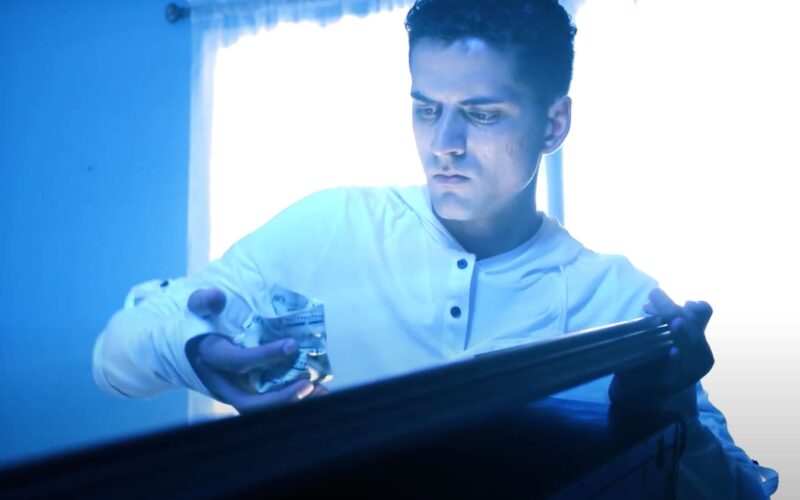
Ethan Grover’s Counterpart broke new ground in science fiction storytelling, presenting a rare and striking narrative approach: a story told with a single performer, in one location, and without dialogue, relying entirely on its visuals and sound to carry its emotional weight. Following its release, the film circulated through the international festival circuit, screening in competitive programs across North America, Europe, and Asia. During its run, it reached audiences in more than twelve countries earning multiple awards for its innovative storytelling.
The film’s international reception demonstrated that Counterpart had the creative ability to grow beyond a standalone short. Among those who engaged with the project was G-Unit Studios, whose development team responded to the film’s distinctive visual style and its original approach to filmmaking. The film’s innovative use of cinematography, mise-en-scène, and bold stylistic choices was not seen as a limitation, but as a scalable creative language capable of supporting a longer, more expansive narrative.
The resulting series pilot, Metronome, grows directly out of the narrative foundation established in Counterpart. While the short concentrated on a composer’s isolated moment of creative disruption within a confined space, the pilot broadens the scope to explore how that creative force begins to impact the world beyond the individual. The shift moves the story away from internal reflection toward consequence-driven storytelling.
The pilot follows Theodore Adriano (Jacob Huey Correa), the composer introduced in the short, now situated within a larger narrative shaped by loss, suspicion, and investigation. His connection to the metronome previously abstract and symbolic becomes the trigger for a murder inquiry. Ideas that functioned metaphorically in the short are recontextualized as drivers of plot within a procedural framework.
As the story expands, Metronome moves through multiple environments, including private interiors, performance spaces, and investigative settings. This spatial expansion places the concepts introduced in the short into a shared social context, allowing them to interact with systems concerned with evidence, authority, and accountability.
Additional characters enter as points of contrast and inquiry. Detectives Nailah Onai (Natara Easter) and Bruce Thomas (Justin Usle) approach the unfolding events through an investigative lens, testing the implications of the forces introduced in the short. In contrast, Alan Kaufman (Andrew Villarreal) represents an alternate outcome of the same creative impulse, illustrating how inspiration can become destabilizing when unchecked. Together, these figures translate abstract ideas into interpersonal and institutional tension.
Development of Metronome has retained key collaborators from Counterpart, including director Ethan Grover, cinematographer James Nield, and production designer Jayme Mavar, whose continued involvement has been essential in maintaining the film’s distinctive visual language while adapting the material for long-form storytelling. Although dialogue is introduced to support an ensemble cast and investigative structure, the series remains grounded in the formal discipline that defined the original short.
Even prior to release, Metronome has begun to establish an independent profile at the script stage. The pilot was awarded Most Creative Screenplay by the Los Angeles Screenwriting Competition, indicating that the expanded narrative has generated momentum of its own and is positioned to extend and potentially surpass the reputation established by Counterpart.
Within the short-film landscape, relatively few projects move beyond circulation into active long-form development. Counterpart followed a different path by establishing a narrative capable of expansion from the outset. Its progression illustrates how formal restraint, applied with intention, can serve as a foundation for growth rather than a limitation, allowing a short film to function both as a complete work and as the basis for continued narrative development.