


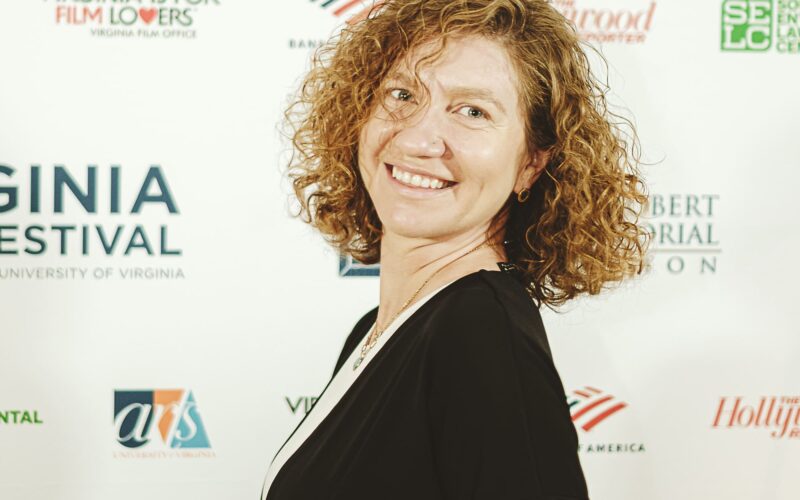
In this interview, Herman reflects on the six-year creative partnership behind the film, the challenges of producing during wartime, and her mission to bring Ukraine’s stories to a global audience.
What first drew you to Divia and to Dmytro Hreshko’s meditative, dialogue-free approach to documenting Ukraine’s wounded landscapes?
Dmitry and I have been working together for six years. We met in a Carpathian forest when I went location scouting in the Carpathians. At the time, he was living in Uzhhorod and was just beginning his directing career. I immediately sensed his potential as an aspiring young director, and we began collaborating. Since then, we’ve made three films together. Divya became our third. Back in the fall of 2021, Dima voiced the idea of making a film about nature and how humanity is destroying it. I immediately agreed, as I also love nature and wanted to highlight this topic. In 2022, when the war began, we adapted the idea to explore how war, as a symbol of humanity, destroys nature. We developed the idea together and worked on the project from the very beginning.We decided at the very beginning that the film would be without dialogue, as we wanted to show that the problems of how humanity destroys nature are common to any country of nationality and that we do not have a planet B.It was also important for us to show the voice of nature and how it experiences all of this, as one of the main characters in our film. This was only possible if we had no other voices in the film, and sound and music would play a huge role in the film. Through sound in our film, we were able to convey all the emotions that nature experiences.
As a Ukrainian producer now based in Los Angeles, how did your personal connection to the war shape your involvement and emotional relationship with this project?
I immigrated to LA in the spring of 2022, when the war began in Ukraine. Frankly, I hadn’t planned or prepared for this immigration at all. It was a challenging but fascinating experience that broadened my horizons as a person and as a producer. It also gave me additional motivation to make Divya a global, international success. When I immigrated, I began to broaden my horizons and developed a passion and interest in making international films about Ukraine in a language everyone could understand, with the goal of raising awareness and introducing the world to our amazing country.
“Divia” blends environmental devastation with moments of resilience. From a producer’s perspective, what was the biggest challenge in capturing this fragile balance?
As a producer, it was important to me to maintain the integrity of the film. I wanted everyone to understand the core messages we laid out in the film’s concept: that nature is one and the same for the entire world, that we don’t have a planet B, and that to change anything in the world, it’s crucial to start with ourselves. With small actions and steps to preserve our planet. It was also important to maintain a fine line so that our film doesn’t become too political.
The film unfolds without narration or interviews. What were the production considerations behind supporting such a purely visual and sound-driven cinematic language?
We decided to have a film without dialogue or language barriers early on in the concept stage, as it was important to us to portray nature as the protagonist and create a language of nature through which it speaks to humanity. War is the embodiment of humanity. We believe the voice of nature can be conveyed through sound, music, and natural emotions such as laughter, breathing, or crying. I hope we succeeded.
With 77 shooting days and nearly 130 hours of footage, how did you and the team decide what moments would carry the emotional and thematic core of the film?
We had a film structure, and it was important for us to find the right shots that would fit that structure. Since the documentary genre is an observational genre, we had to shoot 130 hours of footage over 77 days of filming. From this footage, we had to choose what would match the concept and idea. Once I was able to come to Ukraine, the director and I went to Donbas, a region where military action is taking place, specifically to find the final shots for our film. We had a list of necessary shots, for example, we needed explosions against a forest backdrop and forest fires. So we went to the war zone and waited until we could capture what we needed. It was quite scary and unsafe, but I knew I wanted to be part of it and see firsthand how the war unfolds in my country. And of course, a little later, this personal experience helped strengthen our film during post-production and make it more understandable to the world. Because people who have never been to Ukraine or to the war don’t fully understand how it works. I hope we succeeded.
The project involved a remarkable range of supporters—from Netflix and the Polish Film Institute to Kyiv Biennial and Global Media Makers. How did you navigate such an extensive international co-production?
In 2022, Ukrainian film funding was suspended, and all the money I’d previously found in Ukrainian funds was transferred to the war effort. I realized then that I could only make this film at the level I wanted with a large-scale production. I had no other options. So I knew that only by applying for various international grants and engaging other countries and other producers could I make this project interesting to an international audience. My personal life hack: just do it! Knock on every door, and it will be opened for you. So we applied for every possible and impossible grant. And we succeeded, but to gain such large-scale support, it’s also important to understand that we applied even more often and were also rejected many times. But we didn’t give up!
Many films document the human toll of war, but Divia focuses on ecological trauma. Why was it important for you to produce a film about environmental destruction as a form of war crime?
For me, it was more important to draw attention to the topic of ecology and the idea that nature is one, and Ukraine is simply a terrifying example. What the war is currently doing to nature in my country could happen to any country. And we don’t have a planet B. So with our film, we wanted to draw attention and make people think about how we need to start with small steps, starting with ourselves. And the next point I wanted to draw attention to Ukraine again through a new medium, since people are also part of nature.
The film features deminers, body searchers, ecologists, and animal rescue volunteers. What was the experience of coordinating production around individuals working in such dangerous, emotionally heavy environments?
To be able to film sappers and other specialists, we had to contact various ministries and departments. All these people are very specific due to their professional activities. But overall, we managed this easily by finding an individual approach to everyone, as well as thanks to tolerance and the ability to observe, as is implied in documentary filmmaking.
You have an extensive background across PR, distribution, and film production. How did these combined experiences influence your strategy for bringing Divia to the global festival circuit?
When we were still working on the idea, we immediately realized that our film would be more focused on festival distribution and distribution at special environmental events. Thus, a week ago, we had the honor of screening the film at the UN COP 30 conference in Brazil. My personal experience helped us plan our distribution strategy even during the production stage. While we were participating in various pitches and workshops, we were already promoting our film, as we were already known and anticipated by many festivals. And when the film was finally ready, many festivals invited us themselves.
The premiere at Karlovy Vary and the nomination for the Crystal Globe marked major milestones. What did that moment represent for you as a producer and for Ukrainian cinema more broadly?
From the very beginning, we had our sights set on having our premiere at a class A festival. We applied to festivals of this caliber, and when we were invited to Karlovy Vary, it was expected and gratifying, as our goal had been achieved. I was very pleased that all our efforts and actions were met with worldwide recognition and validation. The Karlovy Vary Festival is one of the best festivals I’ve ever been to, and I can say that when we premiered in a 1,000-seat hall and the hall was full, I felt a sense of satisfaction, like a child being born and seeing the world, and the world seeing them.
You also work in coaching, personal development, and female creative empowerment. Did any of those insights influence how you approached the producing process for Divia?
I only began practicing in this field in 2024, but I’ve been interested in psychology and personal development since childhood. My emigration, the war, and my personal journey, as well as various experiences as a person and professional, have greatly influenced my development in this regard. For example, I’m raising my son alone (he’s now 17). Immigration to the United States is my second emigration; my first was from Crimea to Ukraine. I also began my career in film as a catering woman, so I want to inspire and support others on their journey by sharing my personal experience. And of course, being a psychologist is a very important skill for a producer. This has been helpful in all my projects, as the producer’s work requires such skills for adequate interaction with the team and the creation of films that are as realistic as possible. In Divya, this skill was especially useful when I had to portray a character who experiences all feelings and emotions just like a human being and goes through the same five stages of accepting a situation.
Looking ahead, how does the experience of producing Divia inform your future projects—especially your upcoming directorial debut?
In fact, the idea of trying my hand at directing came to me precisely during the production of Divya, thanks to my active involvement in all creative processes of our film. The director took many of my ideas into account and inspired me with his experience to try directing my next films. I don’t know how Divya’s experience will influence my future development as a director, but I really hope and want to believe that everything will work out as I envisioned. I know for sure that you need to try and experience different things in this life and implement everything that comes to you, even if they seem crazy at first. If you have an idea, a dream, or an intention, it means you have the potential and energy to realize it and bring it to fruition. You just need to go into your fears and do something you’ve never done before, and then everything will work out.