





His recent documentary, The Soul’s Journey: Exploring Faith, marked an important step in that progression. Directed and produced by Velikanov, the film examines faith not as an abstract theological subject, but through personal experience and reflection. The documentary features six-time Emmy Award-winning actor Jonathan Jackson and
explores questions of spiritual transformation, meaning, and the role belief can play in a person’s life.
For Velikanov, the project was also a test of how an independent documentary could move beyond production and reach a broader audience. Following completion, The Soul’s Journey: Exploring Faith received festival recognition, including a Silver Award at the Knoxville International Christian Film Festival (KICFF) and Best Director recognition for Velikanov. The film was also nominated for Best Documentary at the International Christian Film & Music Festival and later secured a distribution agreement with Logos Cinema. The project also received television exposure through broadcasts on WBPI TV49 and Abundant TV.
Velikanov was involved throughout the project as both director and producer, overseeing its development, interviews, visual approach, post-production, and eventual path toward distribution.
“I wanted the film to feel personal rather than instructional,” Velikanov says. “Faith is a very large subject, but the most interesting part for me was how it affects an individual person — the decisions they make, the way they see their life, and the way their perspective can change.”
That interest in people confronting major questions has continued into a very different subject.
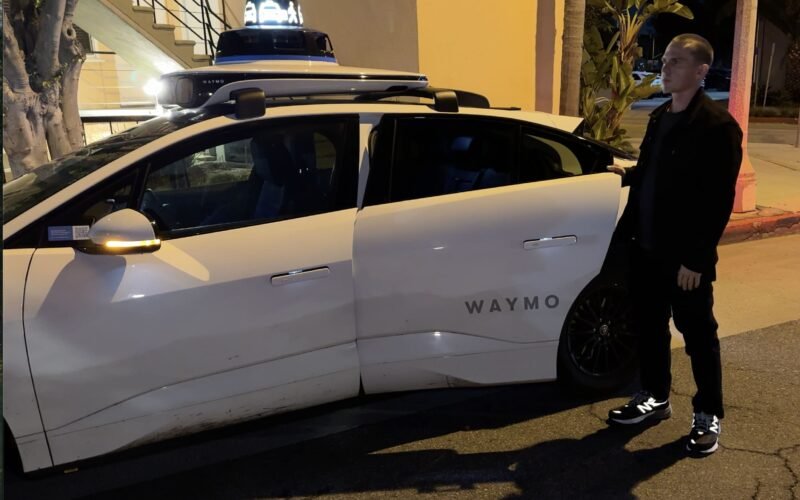
Velikanov is currently directing and producing The Rise of Autonomous Vehicles, a documentary project examining artificial intelligence, humanoid robotics, autonomous transportation, and the increasingly complex relationship between people and intelligent machines.
Rather than approaching the subject purely as a technology documentary, Velikanov is interested in what these developments may mean on a human level.
Production has taken him into real-world environments where emerging technologies are already becoming part of everyday experience. The project has included filming humanoid robots as well as autonomous vehicles in Los Angeles.
“The technology itself is fascinating, but I’m more interested in what happens when people begin interacting with it as something normal,” Velikanov says. “At that point, the story is no longer only about machines. It becomes a story about us.”
The documentary reflects a broader pattern in Velikanov’s work. His earlier projects have moved across subjects that at first appear unrelated but are often connected by an interest in human experience.
His sports documentary Born on the Ice explored the world of hockey and the individuals shaped by it. Velikanov is also developing Resurgence of Hockey Destiny, a new documentary that expands on his previous work in the world of hockey. His earlier films have examined subjects ranging from religion and cultural identity to science and space
exploration.
Moving between these environments has required Velikanov to work not only as a director but also as a researcher and producer — identifying subjects, gaining access to specialized locations, conducting interviews, developing the visual language of each film, and bringing independent productions through post-production and into distribution.
That process, he says, has also changed the way he thinks about filmmaking.
“For an independent filmmaker, finishing the edit isn’t really the end,” Velikanov says. “You still have to find the audience. You have to think about festivals, distribution, broadcasters, and how the film can continue to exist after you finish making it.”
That experience became particularly important with The Soul’s Journey: Exploring Faith, which moved from an independently produced documentary into festival recognition, television exposure, and a distribution agreement.
Now, with The Rise of Autonomous Vehicles, Velikanov is applying the same independent approach to a subject that is developing almost as quickly as the film itself.
Artificial intelligence and robotics continue to change at a remarkable pace, but Velikanov says the central question of the documentary remains relatively simple.
“The technology will keep changing,” he says. “But the question I keep coming back to is what kind of relationship we want to have with it, and what remains uniquely human as these systems become more present in our lives.”
For a filmmaker whose work has explored hockey, faith, and now humanoid robots and autonomous vehicles, that question represents less of a departure than it might initially seem.
The subject has changed. The underlying interest — people trying to understand a changing world — has not.


