


Foreign Tongue explores identity through a highly original premise. What first sparked the idea of using Foreign Accent Syndrome as a gateway into the immigrant experience?
I always made movies about some version of the immigrant experience. This obviously steams from my own experience as a Bosnian refugee as I, after coming to North America (Canada) lived through the cultural shock, the language barriers, the cultural misreadings, the subtle and not-so-subtle exclusions, and the resilience required to keep going. Having an accent is, in many ways a great barrier to integration into a new society, it goes together with the inability to express oneself adequately in a new language. One gets a mark of an outsider which changes people’s persona and the perceptions others have of them but it also works both ways, the foreigners go through an identity cries because they are not who they used to be. Many of my parents friends and even my parents went through a version of this strange life altering process and I observed it first hand. I’ve always been fascinated with all aspects of human duality, the versions of ourselves we carry through our lives. So when it came to this movie, the versions of Kathy through the bizarre event of her waking up with an accent was a long awaited character study I couldn’t wait to explore. The Foreign Accent syndrome idea for Foreign Tongue came from a play by Cynthia Ashperger who also plays Visnja in the movie. To make a cinematic version I wrote a new narrative with a lot of magic realism and focus on Kathy who, in the Bressonian tradition of pure cinema, is the focus of every scene. She becomes the mirror for the audience, the architect inverted.
Kathy’s transformation is both absurd and deeply emotional. How did you balance the film’s dramedy tone between humour, discomfort, and heartbreak in Foreign Tongue?
I wanted to explore her dislocation and invisibility not through anger or cynicism, but through humour, lyricism, and empathy. Through a form of quiet, emotional absurdity that reflects how strange and surreal belonging can feel. For clarity, I think Foreign Tongue is a comedy with layers of varied emotion, truth, honesty and situational exploration. That’s what every film should have regardless of the genre. So my obsession became the drive toward making sure all of the contrasted elements and positive/negative charges in the narrative and the image, came back to comedy. And comedy is hard because of the relative nature of funny. If it’s funny in the script, is it funny on set? If it’s funny on set, does it translate to the screen through the edit room? And if it is funny to us after the edit, will it be funny to the audience? The process is obsessive and neurotic, at least mine is. We had many instances where we almost went over our allotted filming time on some days because we laughed so much as a crew and cast on set. Yet, nothing guaranties the laughter from the audience and, until our first test screenings, I simply didn’t know. The process of filmmaking puts the director, cinematographer, writer and others into a position of being required to do observational adjustments – the ability to know, feel and be able to tell when you are hitting the audience over the head with exposition or preachy monologues or fake emotions. For me, the time between words is as important (or even more important sometimes) than the words actors speak. Same goes with a gesture, a look an actor gives which the camera sees and makes special. Our cast lead by Kim was very receptive to allowing themselves to be in this created world, to allow the audience to feel and think with them.
You describe Kathy as an “insider turned outsider.” Why was it important for you to tell this story through the perspective of someone who unexpectedly becomes “foreign” in her own world in Foreign Tongue?
That inversion is the most fun aspect of the movie for me. The ultimate duality. The foreigner within, Kathy starts to believe that she is foreign because of the way she sounds but that actually gives her comfort and a sense of belonging she didn’t have in her “regular” life. She lives the absurd duality and her life has never been better.
In a narrative focussed on the main character and her unlikely archetype, we needed to give enough of a voice to the community of immigrants, real foreigners who fully accept Kathy in the ESL (English as a second language) class. They themselves are waiting to be accepted by the society as they try to erase the barrier of the accent/language while Kathy attends classes at first to try to get rid of her new obtained accent but soon the classes become her way of being a part of a community. I love this play on the theme of identity. The new thing for Kathy outside of the classroom is the sudden reality in which she is misunderstood, underestimated, misheard, and quietly pushed to the margins just like the real immigrants are. She needed to witness what her new friends are going through as much as the audience did – she now understands their struggle and hardship. Through the interviews in the documentary David is making, the film invites audiences to experience, viscerally and emotionally, what so many immigrants live every day. Having the character of David (being the “archetypical” Canadian) record these interviews was an important symbol of how society easily functions through acceptance.
Your own experience as an immigrant clearly shaped the emotional core of Foreign Tongue. Were there specific personal moments or memories that directly influenced Kathy’s journey?
I think that every moment in the film reflects either mine or our collective immigrant experience., Munire Armstrong (producer), Jasmin Geljo, Cynthia Ashperger, Mladen Obradocvic (actors), Gitanes De Sarajevo (musicians), Juia Blua (editor) and many others in our cast and crew are immigrants who brought their stories and experience to light through this movie. The movie was a magnet for immigrants and kids or partners of immigrants who recognize moments and are very emotional about them, they feel them as their own through Kathy and other characters. We heard this as people read the script and thought filming as well as editing. The same feeling is shared by the limited audience the film has had so far through test screenings etc. and we hope the wide audience once the film is released internationally and domestically shares the same recognition and ownership of the strange immigrant journey Kathy goes through.
Foreign Tongue has been compared to works like Fleabag and My Big Fat Greek Wedding, while also carrying a distinctly Balkan sensibility. What were some of your cinematic or literary influences while developing the film?$
That’s such a potent question in our case. My friends and crew know, and make fun of, my obsession with film and art references – I think references are the best way to illustrate and shape a developing idea, so I always communicate with a barrage of references in prep and on set. My close friend and camera operator Joe Turner often jokes that “Boris wins the reference Olympics again with this one” referring to a booklet of guidelines I make for every project which we call The Manifesto. Since I was writing the movie for about a year or so, I had a chance and too much time to think of the references but I had the hardest time to find references for this movie, tonally, narratively, even visually. This carried into prep and I never even made The Manifesto, for the fist time in 15 years! I still don’t know why, it might be that Foreign Tongue has such a unique premise, there aren’t many movies like it. So I resorted to melanging the feeling I get from films which I wanted to apply to some of the scenes in the movie. One of my favourite movies Dirty Pretty Things (Frears) with the “secret” life of immigrants and the way they have to operate to survive in that movie inspired some of the set up of our immigrant world. My Greek Wedding and the loud, strange, funny rituals in that movie had many parallels with our world, the Bosnian rituals and explanations of our sayings and swear phrases is akin to the feel of Greek Wedding. We also went very broad and grabbed to “the feel” of movies like Playtime (Tati), Night on Earth (Jarmush), A Woman Under the Influence (Cassavetes) and Dreams (Kurosawa) was the inspiration for the dream world of Jung and the treatment of the image.
The idea that accents can instantly change how people perceive someone feels incredibly relevant today. What conversations about identity, belonging, or prejudice were you hoping audiences would reflect on after watching Foreign Tongue?
Because we live in very anxious times and the world is in a fragile state, I wanted the film to have a gentle way of asking questions and making statements. As the entire film is a symbol and a statement, we never backed off from putting forward the issues of immigration, alienation and the change in how foreigners of different sorts are treated by the governments around the world. After all, this film invites audiences to experience, viscerally and emotionally, what so many immigrants live every day.
This is why it was important to me to show the world through use of magic realism and a subtle fairytale-like structure – Kathy is Snow White and the prince is the accent she wakes up with -both her curse and her awakening. Kathy is a mirror, an unwilling symbol and a contradiction – both insider and outsider at once. In that contradiction lies the soul of the film. She embodies the tension between visibility and invisibility, belonging
and estrangement, humour and heartbreak.
In a world increasingly shaped by migration, polarization, and debates over who “belongs” where, Foreign Tongue tries to ask questions of identity, language, and cultural difference in a comedic, somewhat abstract but very honest and real way. The problems and feelings in our movie are political, personal, and deeply human. This film responds to the state of the world not with slogans but with story and not with certainty but with curiosity.Ultimately, Foreign Tongue is about learning to listen – to accents, to silences, to people we think we understand but often don’t. It is about discovering that “foreignness” is not a flaw, but a perspective and that empathy, sometimes, begins with misunderstanding.
I made this film in the hope that audiences might laugh, feel unsettled, recognize themselves, and perhaps leave the theatre seeing the world – and each other – a little differently.
Visually, Foreign Tongue blends grounded realism with touches of magic realism and fairytale-like imagery. How did you approach creating that poetic visual language with cinematographer Fraser Brown?
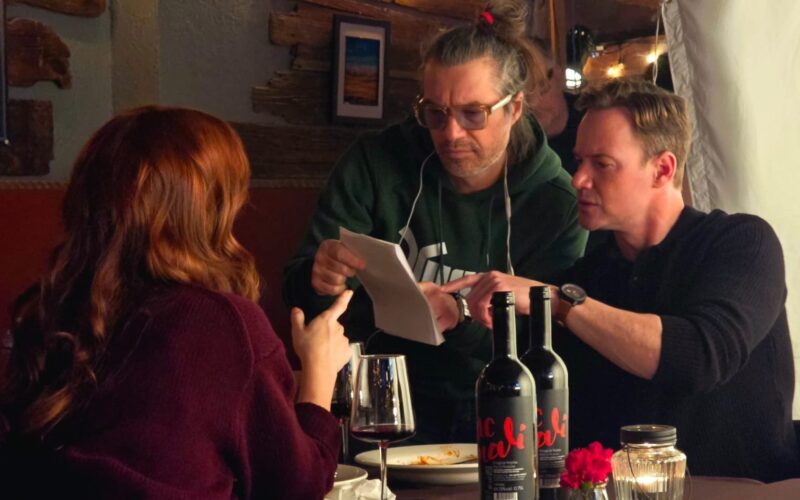
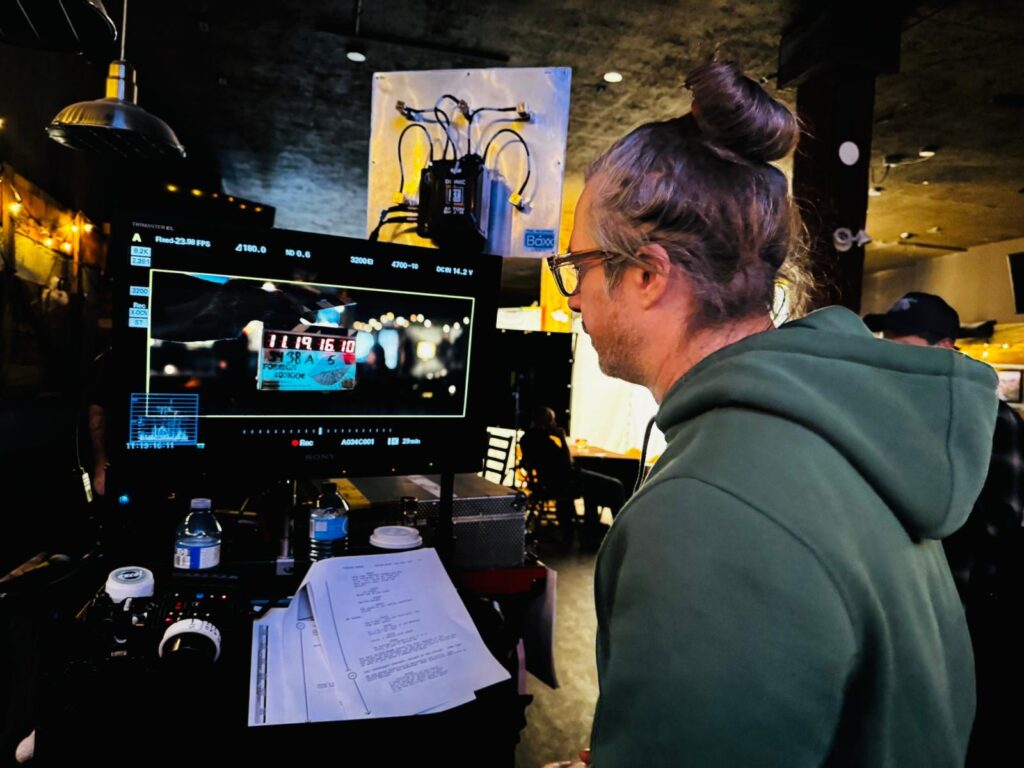
Some of this answer refers to the issues of the missing Manifesto but Fraser and I go way back and are super close friends. I was his mentor once upon a time and since then we had become collaborators on many projects. So we have a very significant shorthand. This was very important because Fraser could not prep the movie because he was on another project and he joined us only a few days before we started filming. So I prepped the movie as a director and cinematographer hoping I don’t screw anything up for Fraser once he has to execute on set. I sent images of locations and angles I’m thinking about as well as the art direction notes but, more importantly, we had agreed on visual simplicity and invisibility of the filmmaking. Visually, we wanted the film to live in a space of grounded poetry, cinematic realism with room for metaphor. We wanted the rhythm to move between light and dark, comedy and unease, intimacy and distance, mirroring the emotional charges within the narrative itself. The images carry both weight and levity, with human duality always represented in framing and compositions. Fraser and I both like very natural and super soft light and our framing choices (carefully designed with our long time collaborator and close friend, the super-camera operator Joe Turner) were informed by the 1:2.39 aspect ratio and the character’s state of mind. I’ve had the great pleasure to work with the same crew of good friends for a very long time and, while that pays off on every project, on Foreign Tongue, it became the biggest asset – rarely did we need to communicate about the filmmaking execution, it was all given and understood once our goals were established. Our producer Felipe Rodriguez who has been a part of that crew as well, together with our producer Munire Armstrong took away the stress of production and time, while Fraser and his crew flawlessly and brilliantly managed the visuals so I could concentrate on the actors and the narrative aspects. It was the easiest movie to execute to date for us.

You’ve had an impressive career both as a director and cinematographer on projects ranging from 12 Monkeys to Titans and Rabbit Hole. How has your cinematography background influenced the way you directed performances and constructed scenes in Foreign Tongue?
Throughout my career, I’ve been asked if I prefer being a director or cinematographer since the combo is not very common and the dual career path is not the norm. So my answer was, and still is, I’m a filmmaker who can take on both roles (as well as writing which I probably love the most). This makes it very natural and easy for me to observe the filmmaking process and execute with understanding and speed and be helpful to cinematographers or directors in any given situation. With Foreign Tongue, knowing that the movie lives or dies with Kim’s performance, I needed all the space I could get to constantly shape the script and spend time with the actors, making sure the comedy and the drama as well as the accent holds and feels real. With such amazing actors, the execution on set was easy, Kim, Steve, Cynthia, Jasmin, Janet, Rachael and the entire ensemble elevated the material and had so many great ideas that were implemented on set through improv or script adjustments on the weekends. I just needed to steer the ship and make sure we are making the same movie all the time.
Kathy’s journey is ultimately about empathy and learning to truly listen to others. Did making Foreign Tongue change or deepen your own perspective on identity and cultural perception in any way?
It reaffirmed things I felt for a long time and it also allowed me to put the ideas into the universe in a meaningful way all the way to the completion of the film. There is a very unique aspect of filmmaking that separates it from other arts – the process requires many stages, the script first but once it is done, you have a script, not a movie. Then the process of filming but once that’s done, you have a bunch of footage but not a movie. The editing brings it all closer to the final but before sound, music, color timing etc. is done, there is no movie. Only the final stage is a piece of art, everything before that doesn’t stand on it’s own but sometimes feels like an achievement before the movie is actually done. So, completing this movie with its themes, ideas, symbols and aims definitely allowed me to learn new things about all the things the movie is talking about.
Foreign Tongue feels both timely and universal in its themes. What do you hope audiences around the world will ultimately take away from Kathy’s story?
I kind of answered this already above but if I had one thing I’m hoping the audience feels/thinks after watching the movie – it would be to think about how it feels to be in someone else’s shoes and have more of a humanitarian outlook to life.